Every author eventually hits the same fork in the road. Your manuscript is finished, or close to it, and now you're facing a decision that shapes everything that comes next:
Do you pursue a traditional publishing deal, or do you self-publish?
It's not a simple "better vs. worse" question, despite how it's often framed online, in writing forums, and across countless "publishing advice" posts that tend to pick a side and defend it as though it's universal.
Both paths have produced successful, celebrated books that readers love. Both paths have also produced authors who chose wrong for their specific goals and regretted it a year in, wishing they'd understood the trade-offs before signing a contract or investing months of production time and budget.
The right answer depends entirely on what you actually want out of publishing, your timeline, your appetite for creative control, and how much of the business side you're willing to take on yourself.
This guide breaks down the real differences between traditional and self-publishing, honestly, so you can figure out which path actually fits the book you've written and the author you want to be, rather than choosing based on assumptions.
WHAT "TRADITIONAL PUBLISHING" ACTUALLY MEANS TODAY
Traditional publishing means a publishing house, often after securing a literary agent, acquires the rights to your book and handles its production and distribution. In exchange, you typically receive an advance against future royalties, followed by a smaller ongoing royalty percentage once that advance is earned back.
The publisher handles editing, cover design, printing, distribution to bookstores, and a portion of the marketing. In return, you give up a significant share of creative control and a large percentage of your earnings per copy sold.
WHY THIS ROUTE CAN TAKE YEARS
Querying agents alone can take months to over a year. Once signed, it's common for 12 to 24 months to pass between a book deal and the book actually appearing on shelves. If you're hoping to publish quickly, traditional publishing rarely accommodates that.
WHAT SKIPPING THIS STEP COSTS YOU
Self-publishing means you, as the author, retain full rights and take on the responsibilities a traditional publisher would normally handle, either by managing them yourself or by hiring the professionals to do it on your behalf while you stay in control.
This is the part that gets misunderstood most often: self-publishing does not mean doing everything alone with no support. It means you own the decisions and the outcome, but you can absolutely still work with editors, cover designers, and formatting specialists.
The difference from traditional publishing is who's driving, not whether professional help is involved.
WHY THIS ROUTE CAN MOVE IN WEEKS, NOT YEARS
Self-publishing can move as fast as your production quality allows. Once your manuscript is genuinely ready, edited, designed, and formatted properly, a book can go live within weeks rather than years.
That speed is one of the biggest draws for authors who don't want to wait on someone else's acquisition calendar.
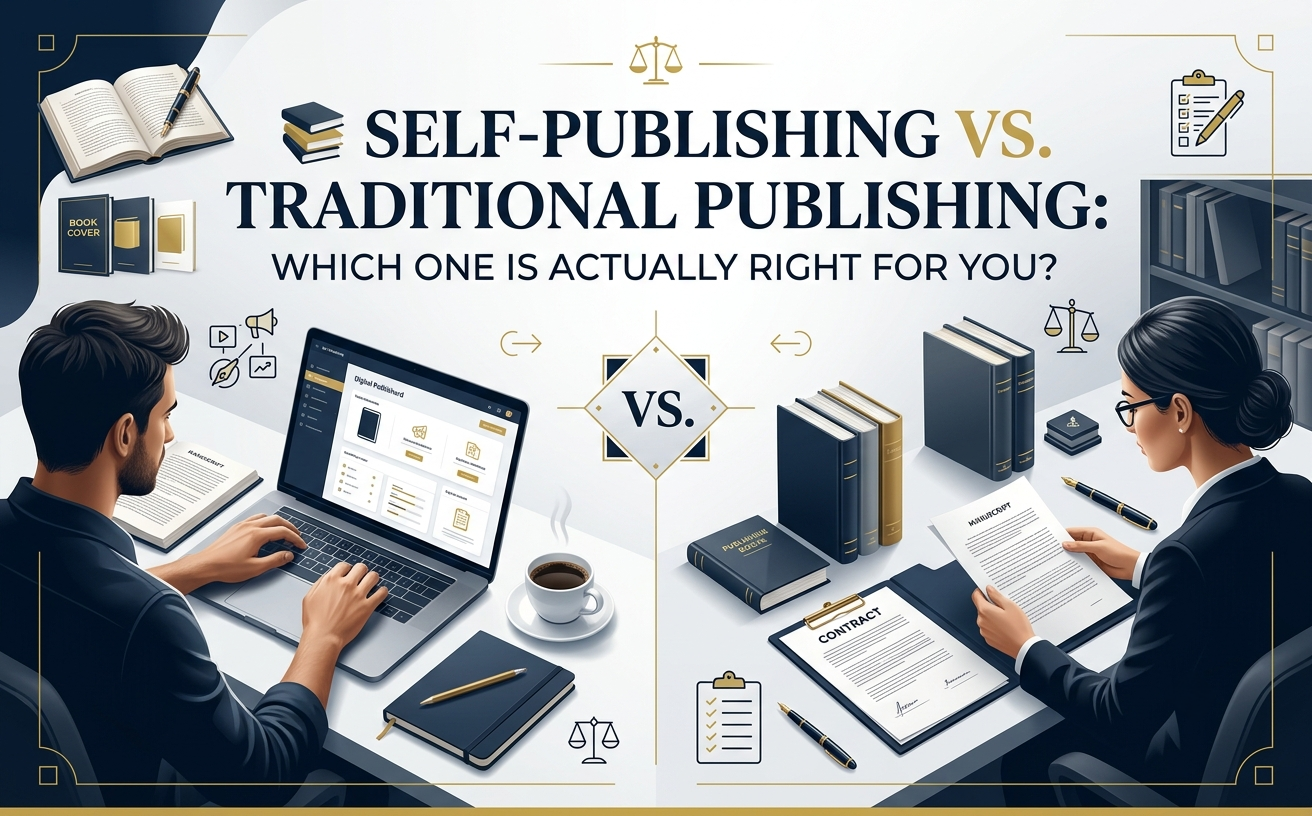
SELF-PUBLISHING VS. TRADITIONAL PUBLISHING: A SIDE-BY-SIDE COMPARISON
| Factor | Traditional Publishing | Self-Publishing |
| Creative control | Limited, publisher has final say on cover, title, edits | Full control over every decision |
| Timeline to publication | Often 12–24 months | Weeks to a few months, once production-ready |
| Royalties | Typically, 10–15% of net | Can reach up to 70% on eBooks |
| Upfront cost to author | Minimal, publisher funds production | Author funds editing, design, and formatting |
| Access | Requires agent/publisher acceptance | Open to any author |
| Bookstore distribution | Stronger, established retail relationships | Possible, but generally harder to secure |
| Marketing support | Some, but often modest for debut authors | Author-driven, or managed through a publishing partner |
Neither column is objectively "better." They represent two different trade-offs between control, speed, and who carries the financial and business burden.
ASK YOURSELF THESE BEFORE YOU PICK A LANE
JUST HOW MUCH CONTROL DO YOU ACTUALLY NEED?
Some authors want a partner to make the hard calls, cover art, title changes, and editorial direction, and are comfortable trading control for that support. Others have a very specific creative vision and don't want anyone altering it. Be honest about which type of author you are; this alone often settles the decision.
CAN YOU REALISTICALLY WAIT TWO YEARS?
If you're writing to build a body of work, a business around your writing, or simply don't want to wait years for a single title to reach readers, the traditional timeline can feel like an obstacle rather than a benefit.
ARE YOU READY TO BE YOUR OWN PUBLISHING BUSINESS?
Self-publishing means you (or a team you hire) are responsible for editorial quality, design, formatting, and getting the book actually discovered. That's not a downside if you're prepared for it, but it's a real responsibility, not just a formality.
DOES YOUR GENRE EVEN REWARD TRADITIONAL PUBLISHING?
Certain genres and categories, particularly fast-moving fiction genres like romance, thriller, and fantasy, have thriving, well-established self-publishing markets with readers who actively seek out self-published titles. Others, particularly certain literary or prestige categories, still lean more heavily on traditional publishing credibility. Understanding where your book fits matters.
THE THIRD OPTION MOST AUTHORS DON'T KNOW EXISTS
Many authors don't realize there's a real middle path between the two extremes. Hybrid publishing means working with a professional publishing partner who provides the editorial, design, and production quality of a traditional house, while you retain the ownership, royalty structure, and creative control of self-publishing.
This model exists precisely because most authors don't actually want to choose between "give up all control" and "handle every technical detail myself." It's often the most practical fit for authors who want a professionally produced book without gambling months or years on the traditional query-and-acquisition process.
WHAT NEITHER PATH PUTS IN THE BROCHURE
WHAT TRADITIONAL PUBLISHING DOESN'T ADVERTISE
Landing a traditional deal can feel like the finish line, but for most debut authors it's closer to the starting line of a different set of demands.
Publishers increasingly expect authors to arrive with an existing audience, a "platform," and to actively participate in marketing even after the book is picked up.
The advance, often smaller than authors expect for a debut, gets paid out in installments tied to milestones, not as a lump sum on signing. And once the manuscript is acquired, authors frequently have far less say than they anticipated over the final cover, title, or even structural edits.
WHAT SELF-PUBLISHING DOESN'T ADVERTISE
On the flip side, self-publishing's flexibility comes with a cost that's easy to underestimate going in: everything that a traditional publisher would normally absorb, editorial quality control, design, formatting, metadata strategy, becomes your responsibility to fund and manage, or to delegate to the right people.
Authors who go in expecting self-publishing to be "free" often end up either underinvesting in production quality, which shows in the finished book, or spending more than anticipated once they realize how many moving pieces a genuinely professional release requires.
Neither of these hidden trade-offs should scare you away from either path. They're simply the parts that don't make it into the simplified "which is better" comparisons online, and understanding them upfront means you're choosing with your eyes open rather than being surprised six months in.
WHICH LANE ARE YOU ACTUALLY IN?
So, answer honestly, not aspirationally:
- Do you have a firm creative vision you're not willing to compromise on? Self-publishing or hybrid likely fits better.
- Is getting into physical bookstores a top priority? Traditional publishing generally has the stronger existing relationships for this.
- Do you want your book live within months, not years? Self-publishing or hybrid moves faster.
- Are you comfortable investing upfront in editing, design, and production, in exchange for a higher royalty share later? Self-publishing or hybrid rewards that trade-off.
- Would you rather hand off the acquisition, editorial, and production decisions entirely to someone else? Traditional publishing, if you can secure a deal, removes that burden from you.
There's no universally "right" answer here, only the one that matches what you actually want from this book and this stage of your writing career.
DON'T LET A DEADLINE MAKE THIS DECISION FOR YOU
There's no rush to lock in a decision the moment you finish your manuscript, and rushing it is often where authors go wrong. Give yourself time to genuinely research comparable authors in your genre, talk to a few who've gone each route if you can, and get a realistic sense of your own priorities before committing.
A decision made under pressure, chasing a trend, reacting to a rejection, or rushing to "just get it out there" tends to be revisited with regret later. A decision made with a clear view of your own goals tends to hold up, regardless of which path you ultimately choose.
WHAT COMES NEXT: HOW GULF PUBLISHER CAN HELP
Choosing between these paths is a genuinely significant decision, and it's not one you should have to make with guesswork.
At Gulf Publisher, we work with authors across the UAE, Saudi Arabia, Qatar, Kuwait, Bahrain, Oman, and Iraq to build books that meet a professional standard, whether that means a fully self-published title live across 18+ platforms, or a hybrid approach that gives you the support of a publishing team while you keep ownership and control.
If you're still weighing which path fits your book, reach out for a free consultation. We'll walk through your goals, your genre, and your timeline together, and help you figure out the route that actually makes sense, not just the one that sounds impressive.