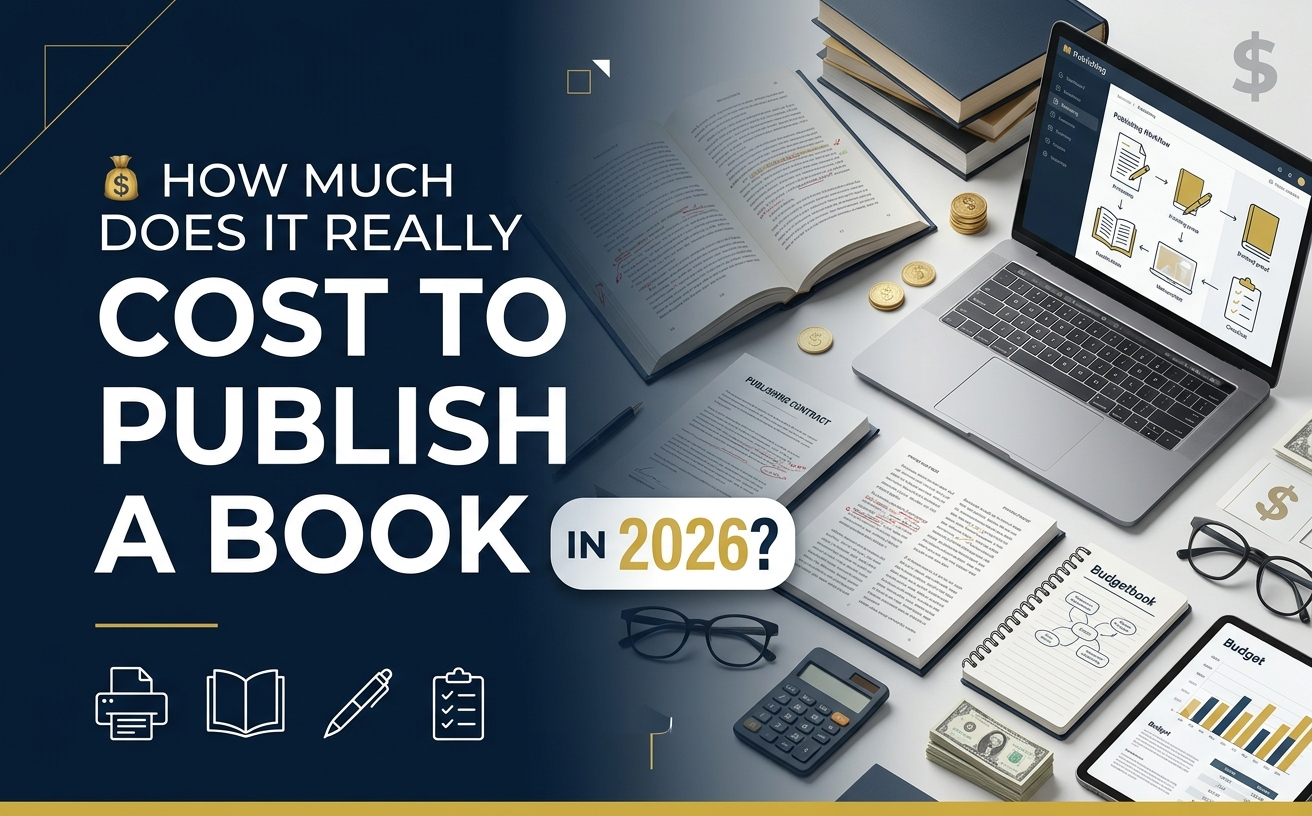
It’s one of the first questions every author asks once they’ve finished a manuscript, and one of the hardest to get a straight answer to.
Search online, and you’ll find numbers ranging from “practically free” to figures that sound more like a small business investment than a book budget. Neither extreme tells the full story, and most articles that promise a single definitive figure are quietly describing one very specific path while presenting it as universal.
The honest answer is that publishing costs vary significantly depending on your book’s length, genre, the quality level you’re aiming for, and how much of the process you handle yourself versus hand off to professionals. But there are real, predictable cost categories behind every published book, whether that cost is paid directly by you or absorbed by a publisher on your behalf.
Understanding those categories is what actually helps you budget realistically, instead of being blindsided halfway through production or, worse, cutting corners on the parts of the process that matter most to how your finished book is actually received.
This guide breaks down where publishing costs actually come from, what drives them up or down, and how to think about your budget without either underspending on the parts readers notice most or overspending on things that don’t move the needle.
STOP LOOKING FOR ONE MAGIC NUMBER
Publishing isn’t one expense; it’s a collection of distinct services bundled together, and the total depends heavily on which combination you need. A 250-page novel has different production requirements than a 60-pagechildren’s picture book or a 400-page business memoir.
A genre with strict reader expectations, like romance or thriller, may need less design experimentation than a book aiming for a distinctive, category-defying look. And critically, the same “publish a book” outcome can be reached through wildly different budgets depending on whether you’re doing the work yourself, hiring freelancers individually, or working with a coordinated publishing team.
This is why generic “it costs $X to publish a book” answers online are often misleading. They’re usually describing one specific path, not the full range of what’s actually possible.
WHERE YOUR MONEY ACTUALLY GOES
THE EDITING BILL: USUALLY, THE BIGGEST ONE
This is typically the largest line item, and for good reason. Editorial work covers everything from big-picture structural feedback down to a final proofread, and the depth of editing your manuscript needs depends on how polished it already is and how many passes are involved.
THE DESIGN BILL: WHAT READERS JUDGE YOU ON FIRST
Your cover is one of the biggest factors in whether a browsing reader clicks on your book at all, and interior formatting affects how professional the reading experience feels, both in print and as an eBook.
Design costs vary based on complexity; illustrated children’s books and heavily formatted non-fiction cost more to produce than a straightforward novel interior.
THE FORMATTING BILL: MAKING IT WORK EVERYWHERE
eBook and print formats require different technical specifications, and getting either wrong creates a visibly unprofessional final product. This is a distinct cost category from design itself, even though the two are closely related.
THE PAPERWORK BILL: ISBNS AND SETUP
Depending on the route you choose, this can range from free (using a platform-provided ISBN) to a modest cost (purchasing your own for more control over how your book is listed).
THE BILL MOST AUTHORS FORGET: MARKETING
This is the category most easily overlooked in budget planning, and the one most likely to determine whether a well-produced book actually finds readers. It ranges from minimal, relying entirely on organic reach, to a meaningful ongoing investment in ads, promotion, and launch coordination.
WHAT ACTUALLY DRIVES YOUR TOTAL COST UP OR DOWN
| Factor | Lowers Cost | Raises Cost |
| Manuscript length | Shorter manuscripts, fewer pages to edit/format | Longer manuscripts, more editorial and design hours |
| Genre complexity | Straightforward text-only fiction | Illustrated, heavily designed, or technical non-fiction |
| Editing depth needed | Manuscript is already well-drafted | Manuscript needs significant structural work |
| Service approach | DIY or piecemeal freelance hiring | Full-service, coordinated professional team |
| Marketing ambition | Organic-only promotion | Paid ads, PR, launch campaign support |
Notice that “cheap” isn’t always the same as “better value.” A lower editorial spend that results in a poorly polished book often costs more in the long run through lost sales, weak reviews, and a damaged first impression with readers.
DIY COSTS VS. WORKING WITH A PUBLISHING TEAM
Authors handling every stage themselves, self-editing, using free or low-cost design tools, and learning formatting through trial and error will spend the least money upfront. But this route has real hidden costs too: time, the learning curve of tools you’ll likely only use once, and the risk of a final product that doesn’t hold up against professionally produced competition in your genre.
Working with a coordinated publishing team costs more upfront, but it bundles editorial, design, formatting, and setup into a single managed process, with each stage handled by people who do that specific work full-time.
For many first-time authors, this trade-off, paying for expertise and consistency versus assembling everything themselves, is the actual decision behind “how much does it cost” more than any single number.
WHERE AUTHOR BUDGETS USUALLY FALL APART
Underestimating editing as a category. Authors often budget generously for cover design, which is visible and exciting, while treating editing as an afterthought, even though it has the largest impact on how the book actually reads.
Forgetting marketing entirely. A book with a beautiful cover and clean editing still needs a plan to reach readers. Skipping this line item in your budget often means skipping the plan itself.
Choosing the cheapest option at every single stage. Piecing together the lowest-cost freelancer for each task can lead to inconsistent quality across the finished book, since nobody is coordinating the overall vision.
Not accounting for their specific book’s complexity. A budget based on a friend’s simple novel won’t necessarily apply to your illustrated children’s book or data-heavy non-fiction title.
Treating the first quote they receive as the market standard. Publishing costs vary meaningfully between providers based on what’s actually included, how many revision rounds are offered, and the experience level of who’s doing the work.
Comparing a single quote against a generic online average, rather than against a couple of real, detailed quotes for your specific manuscript, often leads to either overpaying for less than expected or underestimating what a genuinely thorough process costs.
BUILD YOUR OWN NUMBER, NOT A GUESS
Rather than searching for a single universal number, start by mapping your specific book against the cost categories above:
How long is your manuscript?
How much editorial work does it realistically need?
Does it require design beyond a standard cover and interior?
Do you have any existing audience to launch to, or are you starting from zero?
Answering these honestly gives you a far more accurate starting point than any generic figure you’ll find online, and it’s the same set of questions a publishing partner would walk through with you before quoting a project.
WHEREYOU’RE PUBLISHING FROM CHANGES THE BILL
For authors based in the Gulf region, there’s an added layer worth understanding: costs and options can look different depending on where you’re publishing from and who you’re working with.
Some publishing services are priced for a Western market and don’t account for regional pricing realities, currency considerations, or the specific platforms and distribution channels that matter most to readers in the UAE, Saudi Arabia, Qatar, Kuwait, Bahrain, Oman, and Iraq.
Working with a publishing partner who understands the regional market, not just a generic international service, can meaningfully affect both the cost and the relevance of the final result, particularly if you’re aiming to reach readers close to home as well as an international audience.
FAST, CHEAP, OR GOOD: PICK TWO
Speed is another cost factor that doesn’t always get discussed openly. A rushed production process, skipping a full editorial pass, and using a fast-turnaround designer with limited revisions can lower your upfront cost but often shows in the finished product.
On the other hand, paying for a properly paced, professionally coordinated process typically costs more but reduces the risk of needing costly fixes or a full redesign after the fact.
When comparing quotes or timelines, it’s worth asking directly what’s being prioritized, speed, cost, or quality, since rarely can all three be maximized at once.
WHAT COMES NEXT: HOW GULF PUBLISHER CAN HELP
Publishing costs are confusing mostly because so much depends on your specific book, and generic numbers online rarely account for that. At Gulf Publisher, we work with authors across the UAE, Saudi Arabia, Qatar, Kuwait, Bahrain, Oman, and Iraq to build a clear, transparent picture of exactly what a project needs, editing, design, formatting, and distribution across 18+ platforms, before any commitment is made.
If you’d rather get a real, book-specific answer than guess based on averages, reach out for a free, no-obligation quote. We’ll walk through your manuscript and your goals together and give you a clear picture of what publishing your book actually looks like.